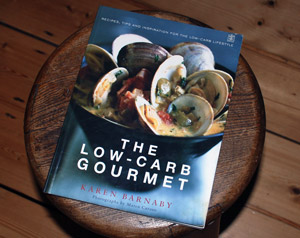
 The Low-Carb Gourmet is written by Karen Barnaby, an executive chef at an award-winning restaurant in Vancouver, Canada. She herself has lost and kept off more than 5 stone through low-carb eating. She wrote this book to share her expertise of cooking low-carb food that is rich and satisfying.
However, I would not have chosen the word “Gourmet” to describe her recipes.
Although really lovely, most of them are very easy to make and not as sophisticated as implied by the word – which I think is a good thing.
Many of the recipes in the book are actually home-cooking classics, cleverly adapted for low-carb lifestyle. For example, there are low-carb recipes for shepherd’s pie, lasagne, moussaka and pizza – and they do not include a shred of potatoes or flour.
There are also some imaginative and unusual ideas in the sections for breakfast, side dishes and desserts – the areas which tend to be more difficult to adapt for low-carb dieting. My favourites include tofu fries and courgette cake.
To me, this is what a good low-carb cookbook should focus on – I get a bit annoyed if I get a cookbook that claims to contain hundreds of low-carb recipes, to find that most of them are variations of “meat plus veg plus a sauce”. Quite frankly, this part of low-carb dieting is very easy, and most of us have it figured out. The difficult part is finding substitutes for dishes that are traditionally carb-based. Karen Barnaby certainly manages that really well, and some of her recipes have become my staple meals that I cook regularly.
The book includes an in-depth introduction, describing Karen’s personal experience and providing some basic guidelines to low-carb dieting. There is a useful section on baking (clearly always a challenge for low-carbers) and an overview of common artificial sweeteners (sorry paleo followers, this part won’t be any good for you).
Another good point about the book is that all ingredients’ quantities are listed as the actual amounts in grams – so the provided carb count is precise. (Some other low-carb cookbooks I have list ingredients in vague terms like “one medium aubergine” – which is no good if you are trying to count your carbs precisely and keep to a very small amount a day, for example, if you are on Atkins Induction.)
Karen is based in Canada but I didn’t have any trouble finding the ingredients she uses in the UK.
Many recipes in the book would be suitable for Atkins diet (including Induction phase) and Dukan (from Cruise onwards). Most recipes are also ok for paleo diets – except for baking/desserts section that tend to use sweeteners and other artificial ingredients.
Overall, this is a really great book of low-carb recipes that are delicious and easy to make. If you only buy one low-carb recipe book, I would definitely strongly recommend this one.
Buy this book on Amazon
Read other low-carb book reviews on our website
Book review – "The Low Carb Gourmet" by Karen Barnaby

Comments
7 responses to “Book review – "The Low Carb Gourmet" by Karen Barnaby”
-
A cookbook is most persuasive when it explains how its recipes stay satisfying within the stated constraint. The review gives the author both professional cooking experience and a personal low-carb background, which helps establish why rich, practical dishes are central to the book’s purpose. Readers would benefit from a few examples of the techniques or ingredient substitutions that carry that promise through the recipes; a guide to AI font generator also benefits from making its practical method visible.
-
The review usefully frames low-carb cooking as a question of satisfying, well-made food rather than simple restriction. Barnaby’s professional cooking background helps explain the focus on dishes that are both rich and practical, while the mention of her own weight-loss history gives context for why the subject matters to the author. A clear recipe structure is particularly valuable here when readers need to adapt everyday meals without losing flavor.
-
A useful team-planning habit is to review defensive overlap before choosing the final moves or items. A Pokémon type chart makes that process clearer by showing where a roster stacks the same resistances and vulnerabilities. It also helps distinguish a manageable shared weakness from one that requires a dedicated switch-in, so team changes can be based on the whole lineup rather than a single matchup.
-
A cookbook review is most useful when it clarifies whether the recipes aim for everyday cooking or simply novelty. Barnaby’s background as an executive chef adds context to the promise of food that remains rich and satisfying while following a low-carb approach. The detail that she maintained substantial weight loss also explains why the book may balance technique with practical eating habits. It would be helpful for readers to know whether the recipes include clear substitutions and pantry guidance, since usability matters as much as flavor in a cookbook.
-
The focus on satisfying low-carb cooking is important, since a recipe collection is more useful when it addresses flavor and fullness instead of treating reduced carbohydrates as a restriction alone. The author’s culinary background gives helpful context for that goal, while the emphasis on sustaining a long-term eating pattern makes the cookbook sound oriented toward everyday meals rather than novelty dishes. A recipe index by main ingredient could further support planning.
-
UPS sizing often becomes confusing because VA, watts, battery capacity, and runtime describe different parts of the decision. Start with the wattage of the equipment, leave sensible headroom, and only then assess whether the estimated battery duration meets the intended use. An UPS wattage calculator is particularly useful for turning a list of devices into a realistic starting load. It also encourages buyers to check whether their equipment needs simple battery backup, voltage regulation, or a different power topology.
-
A timer is most helpful when it removes friction instead of adding another workflow to manage. A browser-based countdown timer with hour, minute, and second controls can suit focused work blocks, cooking, study breaks, and recurring routines. The ability to start, pause, resume, and reset matters because real schedules are rarely uninterrupted. An end sound is equally useful: it lets the timer signal the transition without requiring constant screen checking. A clean, no-sign-up online timer keeps the focus on setting a boundary and returning attention to the task at hand.
Leave a Reply